Tampilkan postingan dengan label Allegan County Michigan. Tampilkan semua postingan

Senin, 10 Agustus 2015

Allegan Forest, Allegan County Michigan - Part 2

Back to our day in Allegan County Michigan.  This was late July.
Wild Bergamot

After Marie and I left Happy Boots Corner we went west on M-89 past Swan Creek Marsh, on the north side of the road is part of the North Country Trail.  We followed along this trail for about 1/2 mile in, then back out.
On this trail we found...
Horse Nettle (Solanum carolinense)  Nightshade family, "the round fruits develop that are a little more than ½" across and half-enclosed by a papery calyx. They become yellow when mature, but are not edible to humans. Each fruit contains numerous seeds that are glossy yellow and flattened",  I think they look like bananas.

Spotted Horsemint (Monarda punctate) Mint Family. Yellow, purple spotted flowers in dense whorls with flowers surrounded by conspicuous white or lilac bracts.


Woodland Sunflower

Harebell


Harebell (Campanula rotundifolia ) Bellflower family.  This is a charming little plant.
We also saw Aniseroot, Lopseed, Striped Wintergreen, Yarrow, a goldenrod, and a few more wildflowers along this trail.

Back in the car we go, deep into the Allegan Forest.
Around the corner and down a two-track to Ottawa Marsh river access along the Kalamazoo River.
Kalamazoo River

 Here we saw Monkey Flower (Mimulus ringens)  Figwort family. These plants are named for their showy flowers, which resemble the heads of grinning monkeys.  I've never seen the "monkey" in this flower. 

There is a Michigan Monkey Flower and it is said that, "A botanist was once served a sprig of Michigan monkey-flower (Mimulus michiganensis) as a garnish on a restaurant dinner plate, leading to the discovery of a new population of this species!"

Common Mallow or Cheeses (Malva neglecta) Mallow Family.

Hoary Vervain (Verbena stricta) Vervain family
There was one Hoary Vervain in the parking area.

Kalamazoo River
We also saw several Tall (American) Bellflower
(Campanulastrum americanum)  Bellflower family

This native plant is an annual or biennial from 2-6' tall.


 Again down the road and around a few corners to our American Columbo field.  What is American Columbo?

We need to go back a few years to 2009 when we discovered some large rosettes of basal leaves here in Allegan County.  Well, Marie (the brains of our duo) concluded these were the basal leaves of the American Columbo! 

We went back to find American Columbo blooming in June 2010.

American Columbo (Frasera caroliniensis) Gentian family


Here is some info on this plant, "American Columbo is an unusual native plant that has a tall striking appearance when it finally bolts and blooms. The greenish white flowers with purplish specks or streaks have an odd appearance; they are produced in great abundance during the blooming period.  This herbaceous plant is a monocarpic (Monocarpic plants are those that flower, set seeds and then die) perennial.


            American Columbo May 14, 2012

It persists as a rosette of 3-30 basal leaves for 5-15 years (or more), finally bolting as a flowering plant that becomes 3-8' tall for a single season, and then dying."
 
     Central stem of American Columbo
 
"American Columbo  is actually a triennial usually taking three years to reach maturity. Two years of basal leaves and the third year a dark burgundy stalk about 1 inch in diameter grows with a terminal flower cluster."
"Leaves: The leaves are whorled. Leaves can reach 18 inches in length. Each leaf is entire.
Flowers: The flowers have 4 Regular Parts and are up to1.3 inches wide.  They are light green with purple spots. Blooms first appear in late spring and continue into early summer. The top of the plant is a large panicle
of flowers.
Habitat: Rich open woods and dry open areas especially limestone soil.
Range: Most of eastern US except extreme north and south. Rare. "


I have to admit it, Marie and I find some interesting things here in Michigan.
But wait there's more!  We found and Marie identified another plant we had never noted before. We noticed it was something different.  I was thinking it might be a knapweed, but she sat right down and made the identification.

 Cylindric Blazing-Star (Liatris cylindracea)  Aster family

"This native perennial plant is 1–1½' tall and unbranched. The central stem is largely hairless, except for a few hairs near the inflorescence. The leaves are up to 8" long and 1/3" across, becoming smaller and fewer as they ascend the stem. These leaves appear whorled because of their density, but they actually alternate around the stem."

"This is a lovely Blazingstar; it is much shorter than most of the others, and tends to bloom earlier. Cylindrical Blazingstar is easy to identify because of the smooth cylindrical surface formed by the green bracts subtending the flowers; this cylindrical surface is longer and larger than what is encountered in other Blazingstars."
Now we know right?

One more before I finally end this.  Whorled Milkweed.  We have seen a few of these plants at Bass River Rec Area but here there were many of them.
  Whorled Milkweed (Asclepias verticillata)  Milkweed family
This native perennial plant is unbranched and up to 2' tall. Whorls of 4-8 linear leaves occur along the slender central stem.


"This little milkweed blooms later in the year than many other members of the genus, and is good at attracting butterflies. The foliage of this plant resembles a horsetail, but the flowers reveal its membership in the Milkweed family. It can be distinguished from other milkweeds by its skinny whorled leaves and greenish white flowers."

Maybe just one more flower this beautiful Butterfly Weed.  It was such a deep red-orange.

Time to wrap up this day in July 2013.  This was the day we saw at least 67 wildflowers, the list is on the last post.  So much fun!

Kamis, 09 April 2015

April 2013 Hepatica Hill, Harbinger of Spring

April 08, 2013  It started as a dark, cloudy day, we decided to go to Hepatica Hill in Allegan County, about 40 miles south of where I live.  We discovered Hepatica Hill, a south facing hill along the Kalamazoo River, from a photographer /blogger, Mark Cassino.  My sister, Marie and I have several favorite places to look for wildflowers and we get pretty excited this time of year.

The thing that stands out for me, at Hepatica Hill, is that everything is cold, gray, and wet, with snow still in ditches and on some trails, but yet, there are these beautiful hepatica blooming.  All the browns and grays, then a beautiful wildflower just growing, fighting the odds, and drabness all around it!
Of course, it is great later on in the year, when there are many, different wildflowers all around but hepatica are some of the first and they are so soft and sweet.


Marie found this cool rock.

                                   At the bottom of Hepatica Hill

Kalamazoo River at Hepatica Hill

We made a very quick stop at our Happy Boots Corner in Allegan County.  I found some Marsh Marigolds struggling to bloom. 
Marsh Marigold buds


There was a steady rain while we were at Hepatica Hill, even with our rain gear we were getting wet so we hopped back in the warm car and checked out some bridges in Allegan County. 


We were driving through Casco Township and came upon Casco Township Nature Preserve.


We passed through a couple cemeteries.
  
  
We drove along the lake shore and stopped in at 121st Avenue road end, a beach along Lake Michigan and Plummerville Creek.               
 Lake Michigan at 121st Ave road end.
    Plummerville Creek flowing into Lake Michigan

But that wasn't the end of our day, we ended up, after still more rain, at the Herrick District Library in Holland, Michigan.  We looked at all the wildflower books, noting the fact that we either own them or have had them on loan from the library.  Then we looked through the Michigan section of the library. 
I found a small photo journal of Casco Township, the township we had just been driving through, and found it very interesting. 
At last it was time to go home, we did have a fun filled day!
Before Marie left to go to her house, I thought we should check my hepatica growing here in my woods, it isn't blooming yet.  Then we checked another area where I had transplanted a few wildflowers that we came across last year growing on the edge of a dirt road, right in harm's way.

There in this small patch was one tiny Habinger of Spring blooming!  I have never seen this plant here in our woods so it was a treat to find it blooming.  It doesn't look like much until you take a close look. 

                      My very own Harbinger of Spring   
 Erigenia bulbosa, also known as harbinger of spring or pepper and salt, is a perennial plant in the carrot family (Apiaceae). E. bulbosa is the only species in the genus Erigenia (Nutt.). This plant is known as harbinger of spring because it is one of the earliest blooming native wildflowers of rich forests in the mid-latitude United States       

Early Spring at Hepatica Hill

Find a sunny south facing slope, in April, somewhere near the Kalamazoo River in Allegan County, Michigan.  Then look closely at the brown leaves, gray twigs, black dirt.  You might just find Hepatica blooming!
Do you see them?

Round-Lobed Hepatica
 Round-Lobed Hepatica buds.


These wildflowers were the high point of our adventure but there was so much more.
First we stopped in Hamilton at the trestle bridge and saw the falls.

Down the road to Happy Boots Corner!  Nice wet woods!

                                             Skunk Cabbage
We walked far to the west coming to Sand Creek.  Along the way we found many interesting things.


Sand Creek, Allegan County, Michigan

Marsh Marigold buds, in a week this will blossom into big beautiful yellow flowers! 

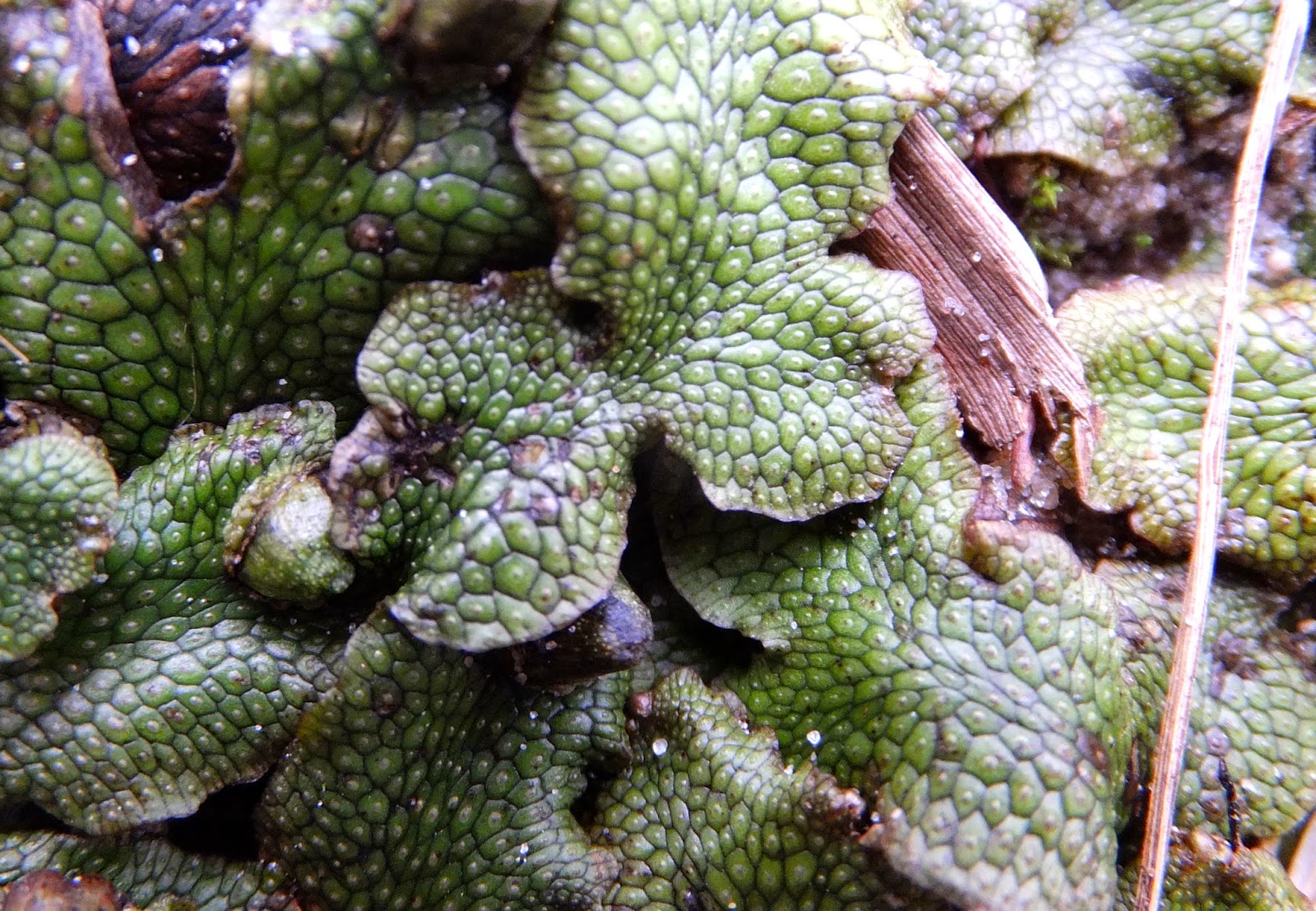
I don't know what this plant is, a moss, liverwort, or something else.  It was quite small.  But it was green in a brown woods so we noticed it. 

And we found rocks.  Big rocks, and they looked different from each other.  This one was gray and white with a bit of pink.
The next one looked totally different, with a flat bottom and round top.

We found wood with trails etched in them, and according to Marie, "That's the S-shaped trails of the Emerald Ash Borer which only eats the inner bark of Ash trees!" 
For a few years we have been noticing trees with the bark damage and wondered what it could be. Here are two examples below.

Damage resulting from woodpeckers, searching for a meal on an emerald ash borer infested tree.  "Woodpecker flecking"

We saw these neat stumps left in a pile...

So much to see!


Then on the opposite bank of Sand Creek I saw liverwort!  Well the creek was just a bit too deep and a bit too wide to cross, so we went back to the snowmobile bridge and crossed there. 
There the creek bank was full of my favorite liverwort.

Later Marie and I did cross the creek on a log but no pictures of that...no pictures.  I took pictures as Marie crossed but no I shouldn't post them.

While we were at Hepatica Hill (named by Mark Cassino) we walked all the way to where Bear Creek meets the Kalamazoo River.  It was a couple miles there and back, and it was a great spring day for a walk.  Like I said earlier, lots of gray and brown, and even some snow on the ground, but as we walked we saw some color flitting about?  It landed maybe 20 feet from us. I zoomed in on it with the camera, trying hard to hold still, and find that bit of orange.

Can you find the butterfly in the picture below?

There it is, circled in black.
It was beautiful, but we couldn't get closer.
 It was not easy to find this Eastern Comma - Polygonia comma  butterfly to get his photo.  We also saw our first Mourning Cloak butterfly of the year.  And a pretty Red Maple tree with flowers.


Looking down at the Kalamazoo River.  So we walked maybe 4-5 miles on this lovely spring day.  It was 37 degrees when we started out in the morning and 8 hours later the temperature was 21 degrees warmer. 
What a great way to spend a day.